
 :
:
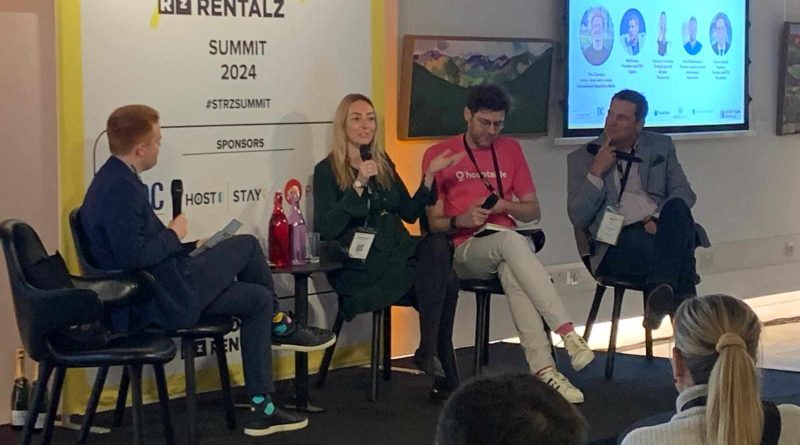
UK: The second STRz Summit was held in London this week [5 November], bringing together influential figures from across the global short-term / vacation rental industry to provide their insights and debate the key challenges facing the sector.
The Summit, which took place at the Bankside Hotel Autograph Collection, featured more than 40 speakers to discuss everything from regulation to mergers and acquisitions [M&A] and investment, loyalty, and the emergence of new online travel agencies [OTAs] to address pain points within the segment. As well as panels, there was a presentation delivered by AB Bernstein’s Richard Clarke about the major OTAs’ earnings reports and their expansion prospects, two debates – one on whether artificial intelligence [AI] is a ‘game-changer’ or if it is being ‘over-hyped’ and the other on whether travel and tourism needs a fundamental reset due to ‘over-tourism’ – and a Startup X-Ray with three startups pitching their brands in front of an expert panel of investors and consultants.
Here are some of the key highlights resulting from the discussions at the 2024 STRz Summit:
- ‘Navigating the investment landscape’
Thought leaders from Host & Stay, Guesty, DC Advisory and PSG Equity explored the current mergers and acquisitions [M&A] and global investment landscape, reflecting on the challenges to dealmaking and providing insights into how to secure different types of funding and how to prepare one’s business for a sale.
Daniel Gennaoui, senior vice president at PSG Equity [which has previously invested in the likes of Inhabit and Hostaway], hinted that hospitality tech investors see the best investment prospects in businesses with white space i.e. targeting segments where there is already adoption and the tech can be scaled globally. One big opportunity that he is observing is with ancillary and upselling tools, where more startups are emerging and launching innovative new solutions for the segment.
A common thread in this panel was the degree of fragmentation in the short-term rental industry, both with a view to investment and mergers and acquisitions [M&A] activity transactions.
Guesty COO and president, Vered Raviv Schwarz, whose own company has closed multiple acquisitions in recent years and closed a $130 million Series F funding round, maintained that there are still widespread tech options in the industry, but that more leading investors are taking interest in the space. For her own company, she said that it got easier to explain Guesty’s unique purpose from Series C funding onwards, as investors would approach them and they had their own data to show trends on where the business and the industry was heading.
DC Advisory’s Nam Quach said that the market remains “flat” and while there are war chests to invest, consumer-facing target acquisition costs are much higher – the more B2C you are, it’s harder to attract capital. Despite the fragmentation, there is also lots of innovation coming through and those that have been in the market for a while will need to keep on their toes.
Also from a growth perspective, Host & Stay’s Dale Smith, whose business closed a recent £10.5 million investment round and embarked on an acquisition spree this year, said that growing organically is tougher as you get larger. Host & Stay is now seeking to consolidate a number of smaller players with 50-100 units, as well as expand into overseas markets, though this will pose fresh infrastructural challenges.
To close, Quach stated that investors will continue to look for future winners and those that are disruptive above anything else. Even in an AI tech world, there is significant potential for more M&A but investors will undertake a risk evaluation of what the impact of AI could be and whether a business can still exist.
- Debate: Over-tourism vs under-tourism: Does tourism need a fundamental reset?
The over-tourism debate has been well documented across the travel and tourism industry throughout 2024 but concerns over tourist levels in highly popular destinations have existed long before that – instead, the phenomenon is receiving wider coverage but the same confusion reigns.
PASC UK’s Alistair Handyside argued that there had been a wide “lack of comprehension” on tourism, which is leading to a disconnect and the misinformed implementation of regulation. One of the key dangers, he said, was making policies without sufficient, adequate data to reflect the true value that the STR sector brings. While cities such as Barcelona and Venice have increasingly unsustainable levels of visitors to keep up with housing / accommodation supply, the governments in England and Scotland still see this sector as being very fragmented and contributing to similar levels of over-tourism, which can drive irrelevant, “one-size-fits-all” regulation in parts of the country that should not be regulated to the same radical extent.
Eva Satkute Stewart, global managing partner, GSIQ Tourism Insights, suggested that destinations had been managing issues of over-tourism since the early 90s, and that short-term rentals had often suffered from blame because of it, even though one specific area does not necessarily contribute to the overall phenomenon. She cited two particular examples of capital cities which had come under the spotlight for dealing with over-tourism in different ways through legislation – Berlin as being more “balanced” in its approach, compared to New York City which had introduced “extreme” legislation.
Offering more of a contrarian perspective, Professor Harold Goodwin of ICRT global said that the causes of over-tourism and under-tourism vary from one place to another, adding that “talking in vague terms does not help”. He insisted that short-term rentals are a housing problem and as more units in large blocks are being given over to the STR market, there is little evidence or data to indicate that these units are providing value to the local economy and regional tourism.
- Increasing transparency and addressing pain points: What next for the OTAs?
Mike Mears [VacayMyWay] and Cathrine K. Reimann [Landfolk] laid out the reasons for more ‘niche’ or specialist booking platforms to emerge and address existing pain points in the industry, while referencing their own experience working at major OTAs in the past [HomeAway and Airbnb].
A key component of this shift will be the platforms’ ability to remove barriers of entry [for example not allowing bookers to pay using Google / Apple Pay etc], enhance the overall booking process and make a consistent end-to-end guest experience, provide clear and transparent pricing structures and verify bookers’ identity for trust purposes.
One potential opportunity for more booking platforms and OTAs to make inroads in is to increase supply in cooler places as the temperatures across the world get higher. As a result, some typically popular tourist destinations might suffer from a drop in tourist numbers when temperatures reach new highs due to climate change and peak seasons become increasingly stretched.
- Debate: AI in hospitality and travel – game changer or over-hyped?
- Pierre-Camille Hamana [Hospitable] discussed how AI can aid the professionalisation of the sector by creating added simplicity. While we are just getting started with AI and explaining what it takes to be a great host, there is a really big opportunity around AI education [both how we are taught to use it and how we teach it] to make it more relevant and accessible for hosts, particularly around data processes.
- Personalisation facilitated by AI is another notable trend in the industry and we are likely to see it open up to different traveller segments from now on, such as neuro-diverse and elderly travellers.
- Matt Loney [Xplorie] reflected that AI can be seen as a tool to allow people, and businesses, to slow down as we head into 2025. Moreover, it can automate the tasks that do not need a human touch and instead enable property managers to focus on other priority areas such as enhancing the guest experience – where personal interaction or a human element is required,
- Suzanne Luscombe [Resicentral] said that AI is not the magic wand it is sometimes made out to be, but it does act as a powerful enhancement tool to add to the tool kit. She suggested that AI could be somewhat detrimental to innovation in the short term if the industry continues to rely on the same tools, and a human touch is still important when data can still be highly subjective. Additionally, current concerns around sustainability and ESG might halt the process of AI adoption, but at some point, we will use AI to work alongside us and we might also use the technology to find hidden patterns or intepretations of data.
The STRz Summit presentations can be downloaded at our page here.
Stay tuned for more information soon on the 2025 STRz Summit and contact Paul Stevens at paul@internationalhospitality.media and Sam Cooper at sam@internationalhospitality.media if you would like to get involved.
Testimonials: